



Let’s be honest — most businesses don’t think about e-invoicing until they absolutely have to. A deadline lands, someone in accounts receivable mentions something about a government portal, and suddenly the whole finance team is scrambling. We’ve seen this pattern play out dozens of times across Austria, and it doesn’t have to go that way. This guide exists so it doesn’t happen to you.
Austria E-Invoicing has moved well past the “optional digital upgrade” stage. It is now a regulatory requirement, one that touches procurement, accounting, legal, and operations — often all at once. Whether you run a manufacturing company in Graz, a logistics firm in Linz, or a professional services practice in Vienna, what follows covers everything you need to know: the regulations behind the mandate, the exact technical requirements, the compliance steps that actually work, and the updates heading into 2026.
What Exactly Is Austria E-Invoicing?
At its core, Austria E-Invoicing is the structured, machine-readable exchange of invoice data between businesses and counterparties — via approved digital channels rather than PDF attachments or manual portal uploads. The invoice isn’t just a document sent electronically. It’s a standardised data file — typically in UBL or CII XML format — that can be parsed, validated, and processed by software on both sides of a transaction without human re-entry.
A PDF invoice sent by email is still “digital” in the colloquial sense, but it fails every test of what regulators actually mean by Austria E-Invoicing. It can’t be validated automatically. It can’t be read by a Peppol access point. It can’t feed into real-time audit infrastructure. That’s the gap the mandate closes — and why businesses that haven’t made the switch are likely to face friction well before any formal enforcement date.
Austria E-Invoice Regulations: The Legal Framework
The regulatory architecture governing Austria E-Invoicing draws from two main sources: EU Directive 2014/55/EU, which established the European standard for electronic invoicing in public procurement, and Austria’s own implementation through the Federal Procurement Act and BMF (Bundesministerium für Finanzen) guidance.
Austria e-invoice regulations mandate that invoices addressed to federal government bodies must be transmitted via the USP (Unternehmensserviceportal) or through a certified Peppol access point. This requirement has been in effect for B2G transactions since 2014 — one of the earlier EU adoptions — but the scope is expanding. State and municipal government buyers are progressively being brought into the same framework, and private-sector B2B obligations are following the same trajectory across the broader EU.
There’s one thing worth flagging plainly about Austria e-invoice regulations: the phased nature of the rollout doesn’t mean the regulations are soft. The requirements — the data fields, the transmission standards, the validation rules — are as strict in the early waves as they’ll ever be. What phases is the population of businesses obligated to comply, not the technical bar they need to clear.
Austria Electronic Invoicing Requirements: What Your System Must Actually Do
This is where things get granular, and frankly, where most of the real compliance work happens. Austria electronic invoicing requirements aren’t just about generating an XML file. They cover how that file is structured, what data it must contain, how it gets transmitted, and what happens when something goes wrong.
Every invoice submitted under Austria E-Invoicing rules must conform to European standard EN 16931 and be expressed in either UBL 2.1 or CII D16B syntax. The mandatory data fields include:
- Supplier and buyer identification, including UID-Nummer (VAT registration number)
- A unique, sequential invoice reference — gaps and duplicates both trigger rejection
- Issue date and, where applicable, the tax point date
- Full line-item detail: description, quantity, unit price, VAT rate, and line total
- Document-level VAT breakdown by tax category (standard-rated, zero-rated, exempt)
- Total amounts: net, VAT, and gross payable
- Payment terms and bank account details
- Peppol IDs for both sender and recipient where transmission is via the Peppol network
Missing any of these fields doesn’t result in a warning — the invoice gets rejected outright. This is probably the single biggest operational surprise for businesses going live. Austria electronic invoicing requirements are enforced at the point of submission, automatically, every time.
Transmission must go via either the USP portal or an accredited Peppol access point. Direct email submission — regardless of invoice format — does not satisfy Austria E-Invoicing requirements. The route of transmission is part of compliance, not just the document itself.
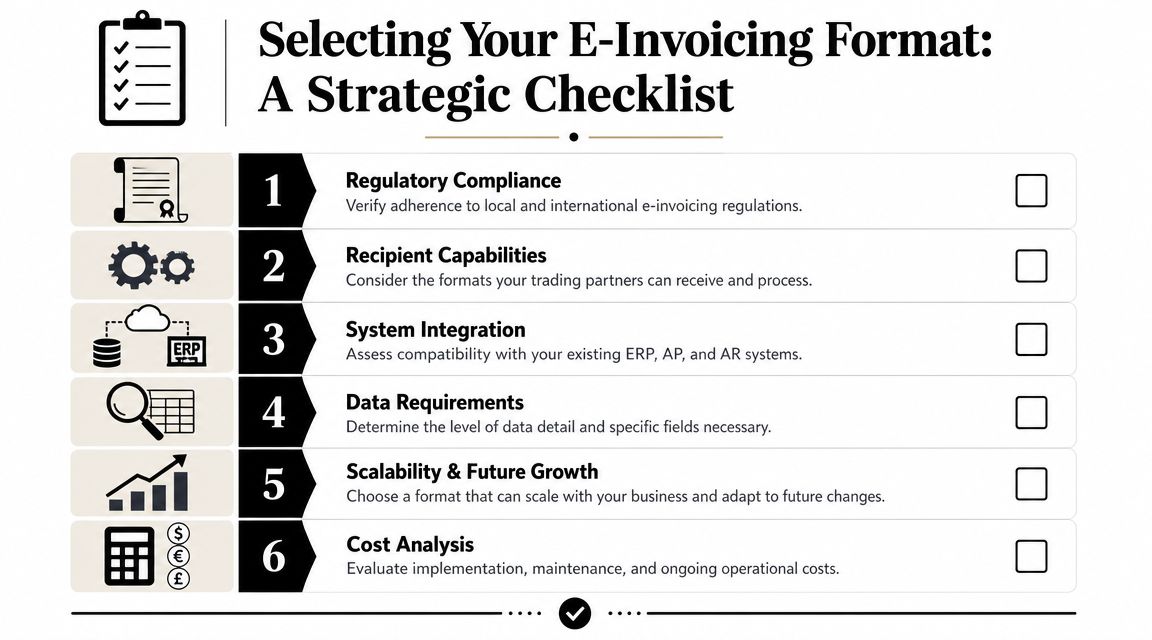
Austria E-Invoicing Compliance: What Good Preparation Actually Looks Like
Austria e-invoicing compliance isn’t a project you hand to IT while finance waits for the outcome. The businesses that navigate this smoothest treat it as a cross-functional initiative — finance owning data quality, IT owning integration architecture, and operations owning change management and staff training.
- Data audit. Know what’s actually in your master data before connecting anything. Incorrect UID-Nummern, missing buyer Peppol IDs, inconsistent product codes — these cause day-one rejections. Budget more time than you think. Teams consistently underestimate this step.
- System assessment. Map every point where an invoice is created, modified, approved, or transmitted — ERP, POS, billing platform, accounting software. Each needs to produce compliant output or feed into a middleware layer that handles conversion.
- Integration configuration. Connect your systems to a Peppol access point through a certified provider. Configure data mapping, XML generation logic, Peppol ID registration, and test the pipeline end to end before any live transactions.
- Validation and piloting. Run real invoices — not synthetic test data — through the full workflow. Capture every rejection, trace each to its root cause, resolve, re-run. Don’t go live until the rejection rate is effectively zero.
- Monitoring and maintenance. Austria E-Invoicing isn’t a project that ends at go-live. Regulations update, tax rates change, Peppol IDs get reassigned. You need a process for keeping configuration current and a dashboard that surfaces exceptions in real time.
One thing that often gets overlooked: Austria e-invoicing compliance has a retention dimension. Invoices must be archived in a format that remains accessible and verifiable for the full statutory retention period — preserving both the structured data and the submission audit trail, not just a copy of the document.
Austria Invoice Reporting Rules: The Filing and Documentation Side
Beyond the invoice itself, Austria invoice reporting rules establish how VAT-related transaction data flows to the tax authority. For most businesses within the Austria E-Invoicing framework, this means periodic UVA (Umsatzsteuervoranmeldung) filings reconciling submitted invoice data against the general ledger — dramatically simpler when invoicing and accounting systems share the same source data.
Austria invoice reporting rules also govern exception scenarios: credit notes, partial payments, invoice amendments, and disputed transactions all have specific handling requirements under the BMF framework. Credit notes must reference the original invoice number and be transmitted through the same Peppol channel — they can’t be issued as standalone adjustments without the documentary link to the original transaction.
For businesses operating across borders — and many Austrian companies do — Austria E-Invoicing intersects with EU cross-border invoice exchange rules. The Peppol network handles this through its interoperability framework: an invoice from an Austrian supplier to a buyer in Germany, France, or the Netherlands travels through the same infrastructure, provided both parties are registered access point participants.
Latest Updates: What’s Changed Heading Into 2026
The Austria E-Invoicing regulatory landscape hasn’t stood still. 2025 into 2026 brought several developments worth knowing about if your compliance timeline extends into next year.
The most significant shift is the progressive extension of B2G mandates to sub-federal government buyers — regional and municipal procurement entities previously outside formal mandate scope. For businesses supplying Austrian state governments, Länder agencies, and larger municipalities, e-invoicing capability is now either already required or approaching its enforcement date depending on buyer category.
There has also been movement on the B2B side. While Austria hasn’t yet implemented a full domestic B2B e-invoicing mandate — unlike Italy, which went further earlier — the EU’s ViDA (VAT in the Digital Age) initiative is pushing all member states toward real-time digital reporting for B2B transactions. Austria’s position has shifted from “we’ll get there eventually” to active preparation. Businesses building compliant infrastructure now will avoid a second implementation cycle when B2B mandates formalise.
One practical update: the BMF updated its Peppol access point certification guidance in late 2024, tightening requirements around cryptographic signing and audit log retention. If you’re working with a provider certified prior to that update, confirm their certification reflects the current standard.
For context on how similar regulatory trajectories have played out in neighbouring markets, our Oman E-Invoicing ERP and POS integration guide documents the implementation patterns that emerge when a mandate moves from B2G into broader B2B scope — the same transition Austria is currently navigating.
How Advintek Global Austria Helps You Stay Ahead
Austria E-Invoicing is solvable. It just requires the right infrastructure in place before the deadline, not after it. Advintek Global Austria has supported businesses across manufacturing, healthcare, financial services, logistics, hospitality, and professional services through the full compliance journey — from initial data audit through to live Peppol submission and ongoing regulatory monitoring.
Our platform connects natively with SAP, Oracle NetSuite, Oracle Fusion Cloud, SAP S/4HANA, SAP Business One, QuickBooks, Xero, FreshBooks, WooCommerce, Shopify, and more. The integration doesn’t require a system replacement — it works with what you already have, adding structured invoice generation, Peppol transmission, BMF validation, and compliance archiving layers your current setup is missing.
We’re a certified Peppol access point. Your invoices go through our network infrastructure directly — no third-party routing. And because we’ve seen what goes wrong during implementations across multiple markets, the project scoping we bring reflects genuine field experience, not a generic playbook.
Final Thoughts
Here’s what we’ve found, working across the Austrian market: the businesses that get this right aren’t necessarily the biggest or the most technically sophisticated. They’re the ones that started early, took data quality seriously, and didn’t treat the compliance deadline as the project start date. Austria E-Invoicing done well doesn’t just check a regulatory box — it builds finance infrastructure that runs cleaner, closes faster, and holds up under audit without drama.
The deadline will come whether the preparation is done or not. Better to be on the right side of it.
Frequently Asked Questions
Is Austria E-Invoicing mandatory for all businesses?
Currently mandatory for all B2G (business-to-government) transactions at the federal level, with state and municipal buyers progressively entering scope. B2B mandates are in development under the EU’s ViDA framework and expected to formalise in coming years.
What format does Austria require for e-invoices?
Invoices must conform to European standard EN 16931 and be expressed in UBL 2.1 or CII D16B XML syntax. PDF invoices — regardless of delivery method — do not meet the standard.
Do I need a Peppol ID to comply with Austria E-Invoicing rules?
For transmission via the Peppol network, yes — both sender and recipient need registered Peppol IDs. Advintek Global handles Peppol registration as part of the implementation process.
How long must e-invoices be retained under Austrian law?
Austrian tax law requires invoice retention for a minimum of seven years. The archive must preserve both invoice data and the submission audit trail in a format that remains accessible for the full retention period.
What’s the difference between Austria E-Invoicing and standard digital invoicing?
Standard digital invoicing typically means a PDF sent electronically. Austria E-Invoicing requires a structured, machine-readable XML document transmitted via an accredited channel (USP or Peppol), validated against BMF rules at submission. The two are not interchangeable under current regulations.
Images generated by AI | Advintek Global Austria